
Colorado is one of the finest places in the country to own a four-wheel drive vehicle. It is also one of the most demanding. The same landscapes that make weekend adventures such compelling rocky mountain passes, river crossings, steep descents, and rapidly changing weather place stresses on 4WD systems that most owners significantly underestimate. Working with an experienced 4×4 vehicle mechanic Denver area drivers trust means your vehicle is serviced by someone who understands these conditions firsthand, not just from a textbook. That local knowledge matters enormously when it comes to keeping a 4WD system reliable in an environment that tests every component thoroughly and regularly.
Steep Grades and What They Do to Your Drivetrain
Colorado’s mountain terrain does not ease you in gradually. The state has more fourteeners than any other in the country, and the roads and trails that wind through them regularly pitch vehicles at angles that place extraordinary demands on drivetrains, differentials, and transfer cases.
On steep ascents, the engine and transmission work significantly harder than on flat ground. Torque demands increase, transmission temperatures rise, and the transfer case works continuously to distribute power between axles. On steep descents, engine braking and differential load increase dramatically particularly when a driver uses low-range four-wheel drive to control speed on a long, rocky downhill section.
What this means practically is that drivetrain fluids, transmission fluid, differential oil, and transfer case fluid degrade faster in Colorado than the standard service intervals account for. These fluids are formulated to handle heat, but sustained high-temperature operation on long mountain grades accelerates their breakdown in ways that flat highway driving simply does not replicate. Colorado 4WD owners who stick rigidly to manufacturer-specified intervals without accounting for mountain use are running degraded fluids longer than their driving conditions warrant.
Rocky Trails and the Suspension System
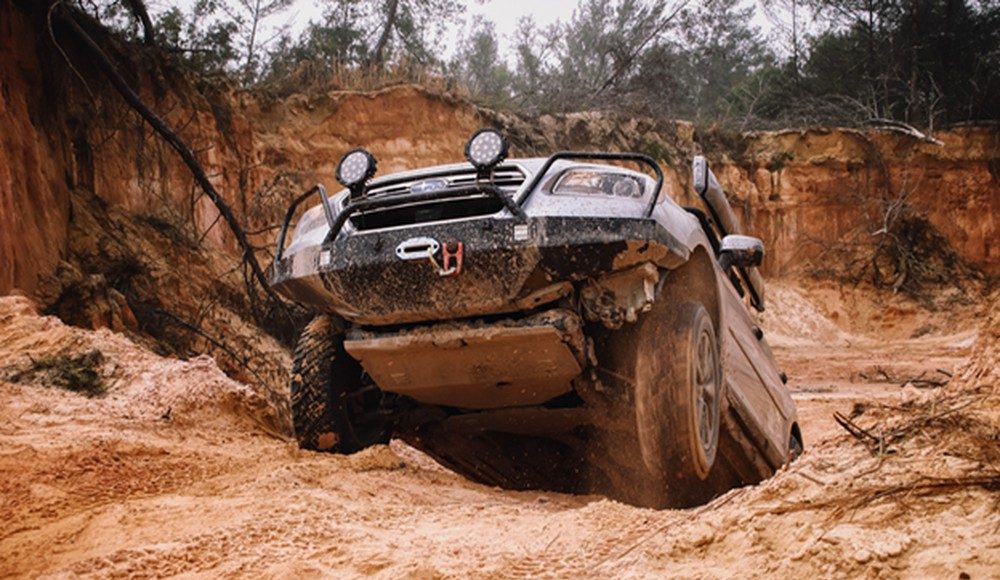
The trails that 4WD owners in Colorado love most are also the ones that punish suspension components most aggressively. Rocky surfaces, embedded boulders, and uneven terrain transmit impacts and lateral forces through every component in the suspension control arms, ball joints, tie rod ends, bushings, and shocks absorb thousands of small hits that collectively take a significant toll on their service life.
Ball joints and tie rod ends are particularly vulnerable. These components allow the steering and suspension to articulate while maintaining precise geometry, and they are not designed to handle repeated high-impact loading indefinitely. When they wear, the symptoms start subtle slight imprecision in steering, minor vibration and progress to dangerous looseness that affects handling and safety on both trails and highways.
What makes Colorado conditions especially significant is that trail damage and highway wear combine. A vehicle that spends Saturday on a rocky trail and Monday on Interstate 25 is accumulating wear through two very different but equally demanding use cases simultaneously.
River Crossings and Water Intrusion
Colorado’s trails frequently cross streams and rivers, particularly during and after snowmelt season when water levels can be deceptively high. Water crossings that look manageable can reach depths that allow water to enter differential housings, transfer cases, and even wheel bearings if seals are not in perfect condition.
Water intrusion into a differential is a serious problem. Differentials rely on lubricating oil to protect gears and bearings under load. When water enters even in small quantities it emulsifies with the oil, dramatically reducing its lubricating properties and creating conditions that accelerate internal wear. The damage does not always show up immediately, which is precisely what makes it dangerous. A differential that was partially water-contaminated during a crossing may run apparently normally for weeks or months before the accelerated wear becomes apparent as noise, play, or failure.
After any significant water crossing, having differential and transfer case fluids inspected and replaced if there is any sign of contamination is a basic but frequently skipped precaution that protects against expensive downstream damage.
Unpredictable Weather and Temperature Extremes
Colorado’s mountain weather is famously volatile. Temperature swings of 40 degrees within a single day are not unusual at elevation, and conditions can shift from dry and sunny to snow-covered in the time it takes to drive from a trailhead to a summit.
These temperature extremes affect 4WD systems in several important ways. Cold temperatures thicken differential and transfer case fluids, increasing the load on gears and bearings during the critical warm-up period before fluids reach operating temperature. Repeated freeze-thaw cycles accelerate the degradation of rubber components CV boots, suspension bushings, and differential seals causing cracking and perishing that opens pathways for contamination and lubricant loss.
Thermal cycling also stresses metal components through repeated expansion and contraction. Joints and fasteners that are marginal in stable temperatures can work loose or develop cracks under the cumulative stress of Colorado’s temperature swings across seasons.
Why Local Expertise Changes Everything
All of these factors sustained grade work, trail impacts, water crossings, and temperature extremes combine to create a maintenance environment that is genuinely different from what most 4WD owners experience in flatter, more temperate parts of the country. Generic service schedules and advice from mechanics unfamiliar with Colorado driving conditions will not fully account for this reality.
The trails, the seasons, and the terrain demand a maintenance approach calibrated to how Colorado 4WD vehicles actually live. That calibration comes from experience from working on vehicles that have been on these specific trails and roads, from understanding what fails first and why, and from building service recommendations around real-world Colorado use rather than theoretical averages. For a vehicle that you are counting on to get you into and back out of some of the most spectacular and demanding terrain in North America, that local expertise is not a luxury. It is the baseline.