
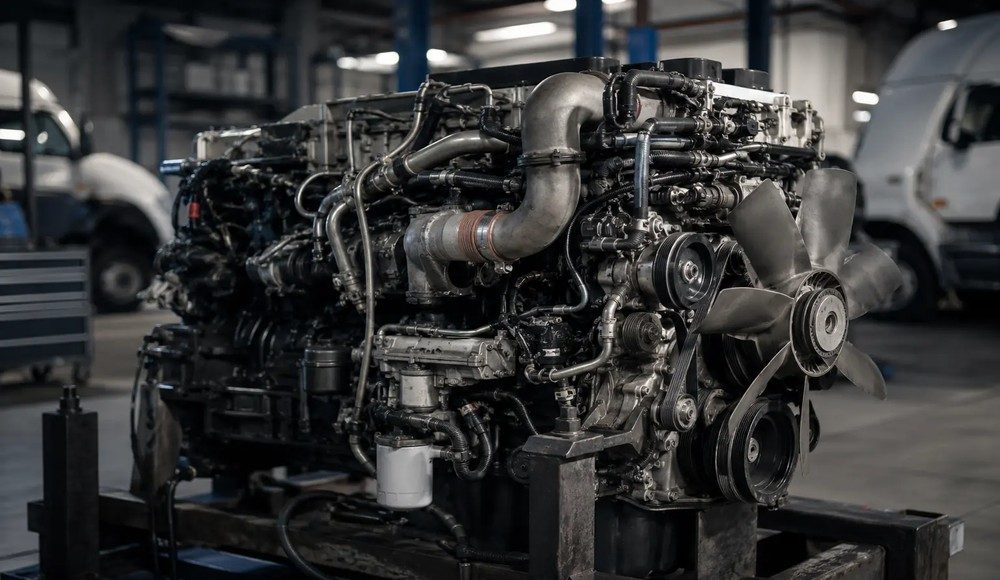


A half-million miles on a gasoline engine is exceptional and unusual. On a well-maintained diesel pickup, it is a reasonable expectation. On a well-maintained Class 8 commercial truck, one million miles between major overhauls is a standard industry benchmark – and some engines surpass two million miles with multiple in-frame rebuilds along the way. These are not outliers or carefully curated showcase trucks. They are the predictable result of specific design principles working in combination with consistent maintenance discipline.
Understanding why diesel engines achieve these numbers – and which maintenance practices are actually responsible for the difference between a diesel that reaches 300,000 miles and one that reaches 700,000 – is useful whether you own a diesel pickup truck, are considering buying one, or simply want to understand what separates long-lived engines from short-lived ones. The answer involves engineering fundamentals that gasoline engines simply do not share, combined with maintenance variables that are entirely within an owner’s control.
The Engineering Reasons Diesel Engines Outlast Gasoline Engines
Diesel engines are not longer-lived because they are diesel. They are longer-lived because the demands of diesel combustion require an engine built to tolerances and specifications that make long service life an engineering outcome rather than a lucky accident.
Compression ratio is the foundational difference. A diesel engine compresses air to ratios between 14:1 and 25:1 before fuel is injected – compared to the 8:1 to 12:1 ratios typical in gasoline engines. Sustaining those compression pressures over millions of cycles requires a fundamentally more robust block, cylinder liners, pistons, connecting rods, and crankshaft than a gasoline engine of equivalent displacement needs. The components that wear in an engine are precisely the ones that diesel engines are engineered to withstand greater forces than their gasoline counterparts ever encounter.
Operating RPM is the second major factor. A diesel engine at highway cruise runs between 1,400 and 1,800 RPM on most heavy-duty applications. A gasoline engine at the same conditions runs between 2,000 and 3,000 RPM. Engine wear is a function of the number of friction cycles those components experience – and at 1,600 RPM versus 2,500 RPM, a diesel accumulates roughly 60 percent fewer friction cycles per hour of operation. Over hundreds of thousands of miles, that difference becomes the gap between an engine that requires a rebuild at 150,000 miles and one that reaches 800,000 miles with its original components still in specification.
Diesel fuel itself provides a lubricity advantage that gasoline does not. Diesel contains natural lubricating compounds that gasoline refining removes, and these compounds benefit the fuel injection system components – pump, injectors, and related precision parts – that operate immersed in the fuel they are delivering. This lubrication reduces wear on injection system internals, which is why high-pressure diesel injection systems routinely outlast gasoline injection components by a significant margin when good fuel quality is maintained.
Finally, diesel engines typically carry more engine oil than gasoline engines of comparable power output, and they recirculate that oil through larger oil coolers. More oil volume means a lower concentration of combustion byproducts per quart of lubricant, which slows the rate at which the oil’s protective chemistry is depleted. Combined with a more effective cooling circuit, the result is an engine that runs cooler, cleaner oil for longer than a gasoline engine in similar service.
What High-Mileage Diesel Engines Actually Have in Common
The diesel engines that accumulate exceptional mileage – 500,000, 750,000, one million miles – do not get there through superior luck or rare factory build quality. When high-mileage diesel trucks are examined and their maintenance histories reviewed, the factors that separate them from engines that failed early are consistent and repeatable.
Oil change discipline is universal among high-mileage diesels. Not approximate discipline – precise adherence to manufacturer-specified intervals calibrated to actual operating conditions. Diesel combustion produces soot, acids, and combustion byproducts that accumulate in the oil from the first hour of operation. An oil change interval that was correct for moderate highway driving is insufficient for a truck that spends significant time at high load or in stop-and-go service. The engines that reach high mileage consistently have owners or operators who matched their service intervals to their actual duty cycles rather than defaulting to whatever the factory manual specified for average use.
Cooling system health is the second universal factor. Every catastrophic early diesel engine failure – the engines that crack heads, warp blocks, or destroy turbochargers at 200,000 miles when they should have reached 600,000 – has overheating as either a direct cause or a contributing condition. Coolant degrades over time, losing its ability to prevent corrosion and cavitation in the water jacket and water pump. An engine running on degraded coolant accumulates microscopic corrosion damage in the cylinder liner walls, EGR coolers, and water pump impeller – damage that is invisible on a service record but cumulative over years of neglect. High-mileage engines almost uniformly have cooling system histories that show regular coolant testing and timely replacement.
Fuel system cleanliness rounds out the top three. Modern diesel engines use common-rail fuel injection operating at pressures between 20,000 and 36,000 PSI, with injector spray nozzles machined to tolerances measured in single-digit microns. Contaminated fuel – water, particulates, microbial growth from stagnant storage, or fuel that does not meet the ASTM D975 specification – degrades these components on contact. Fuel filter replacement on schedule and water separator draining as frequently as conditions require are not optional maintenance items for an engine that is expected to reach high mileage. They are the specific practices that protect the most precision and most expensive components in the fuel system.
The Maintenance Practices That Directly Extend Diesel Engine Life
The framework that professional fleet operators use to structure diesel maintenance – the A, B, and C service intervals that govern oil, filters, cooling system, and major system inspections – is directly applicable to diesel pickup truck owners who want to maximize engine life. Heavy Duty Journal’s complete diesel engine maintenance schedule guide covers the specific intervals, service items, and condition-based adjustments that fleet operators use to routinely achieve million-mile engine life on commercial equipment – the same principles scaled to a diesel pickup context.
Beyond interval discipline, the specific practices that show up repeatedly in high-mileage diesel histories include:
- Warm-up before load: Allowing a cold diesel engine to idle for 60 to 90 seconds before applying heavy throttle gives oil pressure time to fully establish and oil temperature to begin rising. Cold starts without a brief warm-up period expose bearings and turbocharger components to unlubricated metal contact during the window when oil is slowest to reach critical surfaces.
- Cooldown before shutdown: After sustained hard operation – long highway pulls, loaded grades, extended PTO use – a two-minute idle allows turbocharger shaft speed to drop and oil flow to continue while the hottest components cool. Immediate shutdown after hard running cooks residual oil in the turbocharger center housing into carbon deposits that restrict future oil flow.
- Air filter discipline: A diesel engine at highway speed ingests thousands of cubic feet of air per hour. Every particle that bypasses a failed or improperly sealed air filter travels directly to the cylinder walls, piston rings, and turbocharger compressor wheel. Air filter inspection intervals calibrated to the operating environment – not just mileage – are one of the most direct ways to control abrasive wear in the engine.
- Fuel quality sourcing: Purchasing diesel from high-turnover stations where the fuel does not sit in underground storage for extended periods reduces exposure to contaminated or degraded fuel. In humid climates, water accumulation in fuel tanks is a year-round concern, not just a winter one – keeping tanks fuller reduces the air space where condensation forms.
- Load management relative to ratings: Operating consistently at or near a diesel engine’s rated capacity is not inherently damaging – these engines are designed for it. Operating consistently above rated capacity, whether through overloading the truck or through aftermarket tuning that significantly exceeds factory fuel delivery maps, generates heat loads and injection system stresses that shorten component life even when everything else is done correctly.
Reading the Warning Signs Early – What Catches Problems Before They Shorten Engine Life
The engines that fail at 200,000 miles when they should have reached 600,000 almost always showed warning signs that went unaddressed. Blue exhaust smoke indicates oil entering the combustion chamber through worn turbocharger seals or piston rings. Elevated oil consumption between changes – more than a quart per 1,000 miles – is the early quantitative signal of the same problem. White exhaust smoke that persists beyond the first few minutes of a cold start indicates combustion chamber temperatures that are not reaching ignition requirements, pointing to glow plug degradation, coolant contamination, or compression loss. A structured diesel engine troubleshooting approach that systematically addresses each of these symptoms against their most probable causes is how fleet operators catch developing failures weeks before they produce breakdowns – the same approach that applies to a single diesel pickup operated by a conscientious owner.
Modern diesel trucks make early warning easier than the previous generation did. Electronic engine management systems monitor dozens of parameters continuously and generate fault codes when readings deviate from specification ranges. A scan tool with live data capability allows an owner or technician to observe coolant temperature trends, boost pressure deviations, oil pressure behavior at startup, and EGR performance in real time – providing the kind of early diagnostic intelligence that, in previous decades, required specialized equipment and deep technical expertise to access.
The discipline that extends diesel engine life is not complicated. It is consistent. A diesel engine that receives correct-interval oil changes, timely cooling system service, clean fuel through well-maintained filters, and prompt attention to developing symptoms is an engine that is likely to achieve the high-mileage benchmarks that diesel engines are known for. The engine that does not receive those things is likely to fall well short of its potential – not because it was a bad engine, but because the conditions that allow diesel engineering to deliver on its longevity potential were not maintained.
High-Mileage Diesel Pickups – What to Look For When Buying
The diesel truck longevity picture has direct practical implications for buyers considering used diesel pickups. Because diesel engines are capable of reaching 300,000 to 500,000 miles in good mechanical condition, a used diesel pickup with 150,000 miles on the odometer is not a high-mileage concern in the way a gasoline truck with 150,000 miles might be. The more relevant question is not how many miles are on the engine – it is how those miles were accumulated and how the truck was maintained during that time.
Service records are the first filter. A diesel truck without documentation of regular oil changes, filter service, and cooling system maintenance could have experienced the kind of neglect that converts 150,000 miles of potential long life into an engine approaching failure. A truck with complete, consistent records at appropriate intervals tells a more reliable story regardless of mileage.
The condition of the emissions components is increasingly important on post-2007 diesel pickups equipped with diesel particulate filters, EGR systems, and DEF-based selective catalytic reduction. These systems add maintenance requirements that earlier diesels did not have, and neglected emissions components create backpressure, elevated exhaust temperatures, and EGR-related oil contamination that shortens engine life even when the engine itself has been maintained correctly. A used diesel pickup should be evaluated for emissions component condition – DPF cleanliness, EGR cooler integrity, and the absence of emissions-related fault codes – alongside the engine condition itself.
A compression test and a used oil analysis from the current oil fill are the two most diagnostic pre-purchase evaluations available. Compression across all cylinders within 10 percent of specification confirms that rings and liners are healthy. An oil analysis that shows wear metals within normal limits and no coolant or fuel contamination confirms that the engine is not hiding a developing failure. Together, these two tests provide more reliable information about a high-mileage diesel engine’s actual condition than any visual inspection alone can deliver.
The Bottom Line
Diesel engines achieve exceptional service lives because they are built to withstand conditions that gasoline engines are not – higher compression, more robust internal components, lower operating RPM, and inherently lubricating fuel. Those engineering advantages create the potential for 500,000 to one million miles of reliable service. Whether a specific engine reaches that potential is almost entirely determined by maintenance discipline: oil change intervals matched to actual duty cycle, cooling system health maintained through regular testing and timely service, fuel system cleanliness protected through filter discipline, and prompt attention to early warning symptoms before they become expensive failures.
The diesel engines parked at trucking terminals with seven-figure odometers are not special. They are ordinary engines that receive extraordinary maintenance consistency. The same outcomes are available to anyone operating a diesel truck who is willing to apply the same discipline – and the investment in that consistency is small relative to the value of the components it protects.