
If your car shakes, pulls to one side, or feels rough on the road, you might hear two common suggestions: get your tires balanced or get a wheel alignment. These services sound similar, but they fix different problems. Knowing the difference between tire balance vs wheel alignment helps you understand what your vehicle needs before small issues turn into bigger ones.
Both services affect how your car drives. Both help protect your tires. But they do not do the same job.
What Is Tire Balance?
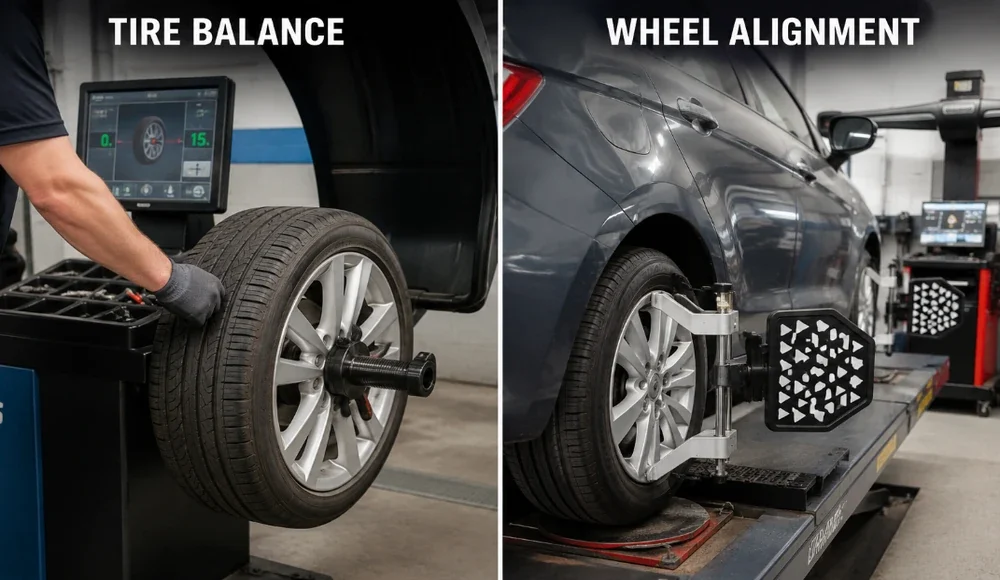
Tire balancing corrects weight differences in the tire and wheel assembly. Even a new tire is not always perfectly balanced. One part may be slightly heavier than another. At low speeds, you may not notice it. At highway speeds, that small imbalance can create shaking or vibration.
During tire balancing, a technician places the tire and wheel on a balancing machine. The machine spins the wheel and finds where the weight is uneven. Small weights are then added to the wheel to balance it properly.
A tire balance problem usually causes:
Steering wheel vibration
Seat or floor vibration
Shaking at certain speeds
Uneven tire wear over time
A rough ride on the highway
The vibration often gets worse as speed increases. Many drivers first notice it around 50 to 70 miles per hour. It can feel minor at first, but it should not be ignored.
What Is Wheel Alignment?
Wheel alignment adjusts the angles of your wheels so they meet the road correctly. It does not involve adding weight to the tire. Instead, it focuses on how the tires sit and point.
A proper alignment keeps your wheels straight and helps your tires make even contact with the road. If the alignment is off, your vehicle may pull to one side, the steering wheel may sit crooked, or the tires may wear unevenly.
Wheel alignment usually checks three main angles:
Camber, which is the inward or outward tilt of the tire
Toe, which is whether tires point inward or outward
Caster, which affects steering stability
Bad alignment can happen after hitting a pothole, curb, road debris, or even from normal suspension wear. It may not always feel dramatic right away, but the damage to your tires can happen slowly.
Tire Balance vs Wheel Alignment: The Main Difference
The easiest way to understand tire balance vs wheel alignment is this:
Tire balance fixes vibration caused by uneven weight.
Wheel alignment fixes direction and tire angle problems.
If your car shakes at higher speeds, tire balancing may be the issue. If your car pulls left or right, or the steering wheel is not centered, alignment may be the problem.
Sometimes, a vehicle needs both services. For example, you might have vibration from an unbalanced tire and uneven wear from poor alignment. That is why a proper inspection matters.
When Do You Need Tire Balancing?
You may need tire balancing when:
You install new tires
You rotate your tires
You feel vibration while driving
A tire has been repaired
Your ride feels rough at highway speed
Balancing is often done during tire installation because it helps the tires roll smoothly from the start. It also helps prevent early wear.
When Do You Need Wheel Alignment?
You may need wheel alignment when:
Your car pulls to one side
The steering wheel is crooked
Tires wear unevenly
You hit a pothole or curb
The vehicle feels unstable
You replace suspension or steering parts
Alignment is especially important if you notice tire wear on one edge. That usually means the tire is not sitting correctly on the road.
Why These Services Matter
Ignoring tire balance or alignment problems can cost more later. Unbalanced tires can wear unevenly and make driving uncomfortable. Poor alignment can shorten tire life and affect control, especially in rain or at higher speeds.
Good tire care helps improve:
Ride comfort
Steering control
Tire lifespan
Fuel efficiency
Driving safety
It is one of those maintenance tasks that feels small, until the problem gets worse.
Final Thoughts
Tire balance vs wheel alignment comes down to the type of problem your vehicle has. Balance deals with smooth rolling. Alignment deals with wheel angles and direction. If your car shakes, think balance. If it pulls, think alignment.
Still, guessing is not always enough. A tire or auto service professional can inspect the tires, wheels, and suspension to find the real cause. Fixing the right problem early helps your car drive smoother, keeps your tires lasting longer, and gives you more confidence on the road.
This post was written by a professional at Tires2Go Florida. Tires2Go Florida is a trusted automotive service center located in Pinellas Park, Florida, serving drivers across St. Petersburg, Tampa, Clearwater, and Largo. Our certified mechanics handle tire and wheel replacement, brakes in Pinellas Park, suspension repairs, oil changes, wheel alignments, tire balancing, and road force balancing. We also specialize in ADAS calibration, suspension modifications, lift kits, and lowering kits using quality parts and modern diagnostic equipment. From routine maintenance to advanced automotive services, Tires2Go Florida provides dependable solutions and tires for sale for vehicles throughout the Tampa Bay area.